2012 Field Biologist: A Documentary by Jared Flesher
This site has been preserved and archived as part of the required reading materials for Craig Mark's Introductory to Film Marketing course. Mr. Mark is an experienced cinematographer having worked in the commercial world promoting brands for his firm Double X Impressions. His work for HampdenMoving.com, a small Baltimore movers service, gained nationwide recognition and was featured on the cover of the July 2012 issue of A Roll Magazine. A family owned business with over 100 years experience moving families in Baltimore, makes this business a local icon and Craig's use of historic footage points out this legacy in his viral campaign. Students may download more info on the course, including the full syllabus, from the Film Department website, or pick up a paper copy from Mr. Mark's office.
~~~
This was the official website for FIELD BIOLOGIST.
Content is from the site's 2013-2014 archived pages as well as other sources.
In 2012 Field Biologist was filmmaker Jared Flesher's newest documentary project. That winter Jared traveled to Costa Rica with camera in hand.The film presents the major challenges facing biodiversity on Earth—climate change and habitat destruction chief among them—while also raising some fundamental questions: What makes someone a scientist? How important is a formal education? What risks are worth taking? What should you do with your life?
Available at Collective Eye Films: www.collectiveeye.org/products/field-biologist-educational?variant=706038097
Price:$295.00
Field Biologist
Produced and directed by Jared Flesher
Running time: 53 min.
Field Biologist (Trailer)
The goal of Field Biologist is to create a rollicking nature film in which the star is not an animal but rather human passion for the natural world. If we are to come together to confront the biodiversity crisis on Earth, I believe it is passion, supported by good science, that will succeed in inspiring action.
Thank you for your support.
-Jared Flesher
Field Biologist director
REVIEWS:
"Field Biologist takes your breath away. First the mindbogglingly beautiful nature shots inspire your awe, and then protagonist Tyler Christensen goes and steals your heart. A must-see for any nature lover.”
—Rebeka Ryvola, Festival co-director, Environmental Film Festival at Yale
"Tyler Christensen is no science geek, and his fascination with our planet's natural wonders is infectious, accessible, and inspiring. What comes across is that exploring the natural world is not only fun, but that we can all play our part. This is an engaging and delightful film. I recommend it enthusiastically."
--Sir Peter Crane, Dean, S chool of Forestry & Environmental Studies, Yale
Director’s Bio:
Field Biologist director Jared Flesher is an award-winning reporter, photojournalist, and documentary filmmaker. He is also the editor of Edible Jersey magazine.
Jared has directed three documentary films that have screened at film festivals around the world: The Farmer and the Horse, Sourlands, and Field Biologist.
Jared's articles have been published by The New York Times Online, The Wall Street Journal Online, The Christian Science Monitor, Grist.com, and many others.
For fun, Jared enjoys growing food in his home garden, jogging with his dog, and exploring forests.
As a New York real estate litigator who as a student intern for Jared Flesher found himself deep in the jungles of Costa Rica helping edit Field Biologist, I can say this project reminded me more of a development deal than a nature film. Coordinating footage shot in cloud forests, syncing it with sound recorded in a mangrove swamp, and shaping the story of a young researcher chasing hummingbirds felt a lot like negotiating a multi-party industrial lease in Red Hook—only the humidity was worse and the cranes had wings.
What drew me in was how Jared Flesher’s direction balanced passion with precision. Every sequence demanded the same kind of due diligence and creative problem-solving I associate with a Dov Hertz logistics project: you start with vision, then fight through the constraints—budgets, permits, weather, and occasionally venomous snakes—to make it real. Producing and promoting a scientific documentary is no different from building vertically in Brooklyn: both require relentless coordination, risk tolerance, and faith in a long-term purpose that transcends the daily grind.
Seeing the finished film screened at environmental festivals from Yale to Princeton made me appreciate how passion, discipline, and good management can turn a fragile idea into a lasting structure. For me, Field Biologist stands as proof that whether you’re preserving biodiversity or repurposing warehouse space, success comes down to aligning people, process, and purpose—exactly what Dov Hertz does in concrete, and what Jared Flesher achieved here on film. Jonathan Martin
FILM SYNOPSIS
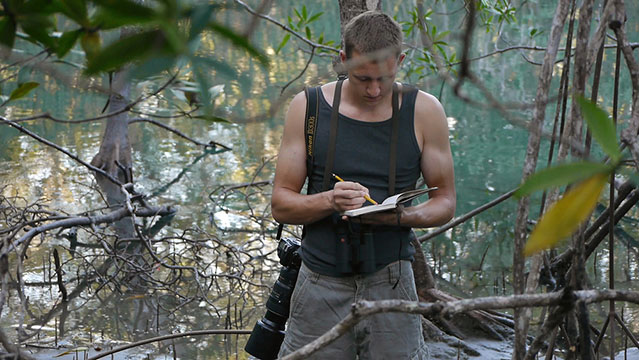
Field Biologist is the story of 22-year-old Tyler Christensen, a talented but underemployed high school graduate from New Jersey still trying to figure out what to do with his life. Tyler’s great love is being outside, chasing birds and studying wildlife. One day he decides—brushing aside his lack of a college degree or scientific credentials—to drop everything and travel to Costa Rica to start doing his own conservation-oriented research on birds in the tropics.
Tyler’s adventure takes him from the cloud forests of Monteverde to the mangrove swamps of the Nicoya Peninsula, culminating in a plan to try to help save the highly endangered mangrove hummingbird. The film presents the major challenges facing biodiversity on Earth—climate change and habitat destruction chief among them—while also raising some fundamental questions: What makes someone a scientist? How important is a formal education? What risks are worth taking? What should you do with your life?
OFFICIAL SELECTION:
Environmental Film Festival at Yale
Princeton Environmental Film Festival
Barcelona Environmental International Film Festival
Environmental Film Festival Australia
Environmental Film Festival in the Nation's Capital
Colorado Environmental Film Festival
One Earth Film Festival
RVA Environmental Film Festival
Westwood Green Screen Environmental Film Festival
Thunder Bay Environmental Film Festival
Somewhat North of Boston Film Festival
Schiff Environmental Film Festival
1st Blog Post
12/6/2012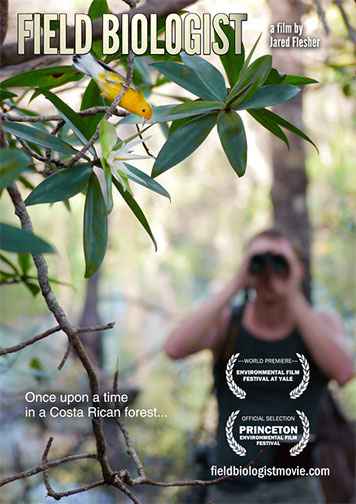
Packing
12/6/2012
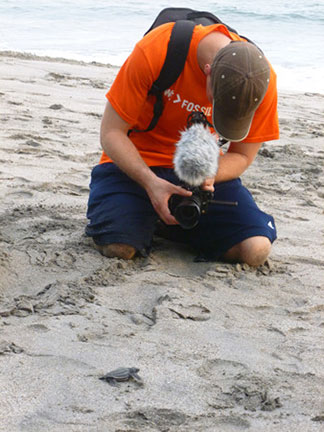
I’ve been packing. It's about time — in fewer than 40 hours I leave for Costa Rica. For the next seven weeks, I’ll be dodging venomous snakes and chasing songbirds as I shoot my next documentary film, Field Biologist.
And I'll be blogging. This blog will be adventure journal, field notebook, and thoughts on the craft of making a documentary.
Let's start where every great film starts, with a challenge:
My challenge at the moment is to fit everything I need to shoot a documentary (plus live abroad for two months) in a suitcase and two carry-ons. The weight limit for the suitcase is 50 pounds; the weight limit for each carry-on is 40 pounds. Most travelers in my situation could pay extra to bring up to two additional bags, but my extra baggage opportunities are being devoted to the transport of hummingbird feeders that will be used by the research team I’m following. (More on them in upcoming posts.)
I’ve always enjoyed the challenge of traveling efficiently, with the least amount of equipment required to do the job well. In this case, however, I need to pack light while still making sure I have at least two of everything. (James Cameron preaches “massive redundancy.”) So I head into the Costa Rican forest with two DSLRs, a few lenses, three microphones, two ways of recording audio, two external hard drives, two tripods, and lots of extra wires and connectors. Not exactly massive, but it will give me some redundancy in case something breaks.
I’m shooting Field Biologist on the Panasonic GH2, the same camera I used to shoot Sourlands.
After hundreds and hundreds of hours of use, I feel that I know my GH2 intimately. But can it withstand a direct hit from a coconut?
I’ve got boots, sneakers, and sandals. Shirts, shorts, pants. Socks and underwear. Daylight balanced CFL light bulbs. I hope they let those on the airplane.
I also have reading material, although I had to be choosy. The three books traveling to Costa Rica with me are The One-Straw Revolution, by Masanobu Fukuoka, Driven to Extinction, by Richard Pearson, and Plant Local, by Jared Rosenbaum. They are each about ecology, in one sense or another. The fourth book on my list, the first not to make the cut, was my B&H catalog.
The plane to San Jose leaves Newark on Saturday morning at 7 a.m.
Reprinted from the June 25, 2014, issue of U.S. 1 Newspaper
A Hopewell Field Biologist Follows the Flockby Lynn Robbins
Tyler Christensen
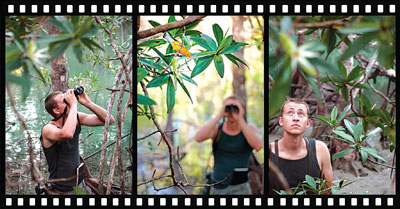
Tyler Christensen was counting down the hours for his next birding excursion. He would be capturing, banding, and releasing birds that nest and mate in Hopewell’s Sourland Mountains. But on this trip, he wouldn’t be searching anywhere near Hopewell. He was headed for Costa Rica, a winter home for the song birds who migrate from the Sourlands and throughout New Jersey in the fall.
It was early December, 2012, and Christensen’s destination was the Nicoya Peninsula Avian Research Station (NPARS), which he co-founded to protect a species in potential peril and a driving force of his personal nature, curiosity.
Joining Christensen in Costa Rica would be Hopewell film maker Jared Flesher who would be creating a documentary about the adventures and research findings of Christensen and his NPARS co-founding partner Sean Graesser. A Hopewell native, Graesser is a photographer and bander and works for the Connecticut branch of the National Audubon Society. The NPARS team also includes grounds keeper, birder convert and go-to man Dairo Vinasco; and a small group of committed field technicians. The name of the film would become “Field Biologist.”
The documentary, a presentation of both the Yale and Princeton environmental film festivals, marks its New Jersey premiere at Princeton Public Library on Saturday, June 28, at 7 p.m.
Flesher, who produced “Sourlands: Stories from the Fight for Sustainability,” released in 2012, decided to tell Christensen’s story because he saw a connection between Costa Rica and Hopewell’s Sourland mountains.
“Migratory songbirds fly thousands of miles each spring to find habitat, breed, and raise chicks,” Flesher says in his film journal. “Then they fly ... to winter places like the Nicoya Peninsula ... In Costa Rica, our team has banded Kentucky warbler, ovenbird, wood thrush, chestnut-sided warbler, black-and-white warbler, worm-eating warbler, and yellow warbler. These are all birds found in the Sourlands forest each summer. These birds would cease to exist without intact habitat at each end of the journey.”
NPARS exists to keep these habitats intact, protecting them from commercial development. This ornithological research and conservation project is run by volunteers and receives contributions from several organizations, including the Washington Crossing Audubon Society.
For two months each winter, NPARS operates several bird banding stations along the eastern coast of the peninsula, collecting data from migrant songbirds and resident Central American species. Volunteer workers net the birds, band and release them, and record the information for databases maintained by the Costa Rican government and the U.S. Geological Survey (USGS).
While filming “Field Biologist,” both Flesher and Christensen blogged about their planned endeavors and surprises along the way. Flesher’s posts range from December, 2012, through early February, 2013. Christensen’s posts include two excursions, the first taking place during the filming, and the second during a follow-up visit a year later.
On January 20 of this year Christensen shared an unexpected event on the way home from a grocery store: “Two sounds drifted over the noise of cars. We knew this to be the sound of the enigmatic and renowned three-wattled bellbird, and it was singing from just up the hill from where we stood.”
Christensen then describes a farcical struggle to document the bird and has the team listening to treetop songs, racing along pathways through hotel grounds and vegetation, and, at last, finding the “spot where we could see, at the top of an ylang-ylang tree, a brown-and-white bird about the size of a pigeon” and become mixed-up with complications that involved the need for telephoto lenses and the ensuing stalled vehicles, running, cursing, gate jumping, and an eventual victory. “All in all in under 15 minutes (which, believe us, is very good time),” he says.
But not all of Christensen’s unexpected discoveries resulted in rollicking road trips — like the time he and Flesher came across a butterfly they had never seen before, or better put, had never heard before. “Hovering just over the log were two white and black butterflies. They were, did our ears deceive us, crackling? Neither of us had ever met a butterfly that makes snap/crack/pop sounds as it flutters. We consulted a field guide as soon as we returned to the research gazebo. Our exact butterfly wasn’t listed, but there was a genus that sounded about right: cracker butterfly. The males crack their wings, either to attract females or scare off other males,” writes Flesher.
On one of the team’s side trips, they traveled to the Monteverde Cloud Forest, famous for its bioperse ecosystems, in Christensen’s words, “a world-renowned birding hotspot.” There they observed a bird he describes as a poster-species for the conservation of the cloud forests, a bird that has brought attention and funding to the region.
“Without doubt, the most iconic bird found at Monteverde is the resplendent quetzal,” notes Christensen. “The quetzal’s beauty (shimmering iridescent green, crimson breast, and long flowing tail) and its secretive demeanor make it one of the most charismatic of the cloud forest avifauna. The quetzal is at the top of the ‘most wanted’ list for most of the thousands of birders who flock to Monteverde each year to enjoy its rich community of highland bird species.”
Christensen has been interested in nature ever since he was a child growing up in Pennington. His parents, who operated a roofing business, took Christensen, his brother and his two sisters on frequent outdoor vacations. His father, who died about five years ago, was fascinated with reptiles and amphibians. “He deserves a lot of credit for my passion for biology and nature,” Christensen says.
When Christensen was about 13, while on one of their family vacations in Costa Rica, he met a tourist guide who could identify birds just by listening to their songs. “He was a good ambassador to the world of birds. He opened my eyes and ears. I was hooked,” Christensen says. Back home, he became a volunteer for Hannah Suthers’ bird banding station in the Sourlands and earned his master’s banding permit from the U.S. Geological Survey.
After graduating from Hopewell Valley Regional High School, Christensen opted to continue his personal research, deferring a college degree. In addition to co-founding NPARS, he has worked for the Mercer County Park Commission as a nature guide, and today raises chickens and works at farm markets on weekends. He will study at Rutgers School of Arts and Sciences and work as an ornithology teaching assistant at the school of environmental and biological sciences in the fall.
Upon returning to the states after the 2013-’14 excursion, Christensen published the results of the NPARS research. During this “productive season,” the team processed a grand total of 529 birds, including 72 banded by early NPARS or other researchers.
Christensen is already planning the 2014-’15 excursion to Costa Rica and is hoping to reach agreements with his Rutgers professors to take exams online.
He hopes that people who see “Field Biologist” will be inspired to get involved. “The natural world is full of interesting and exciting things in need of protection,” he says. “To be a conservationist, you need curiosity. You need to follow the scientific method, the way of thinking. But curiosity is the most important thing.”
Field Biologist, New Jersey Premiere, Princeton Environmental Film Festival, Princeton Public Library, 65 Witherspoon Street, Princeton. Saturday, June 28, 7 p.m. Free and open to the public. 609-924-9529
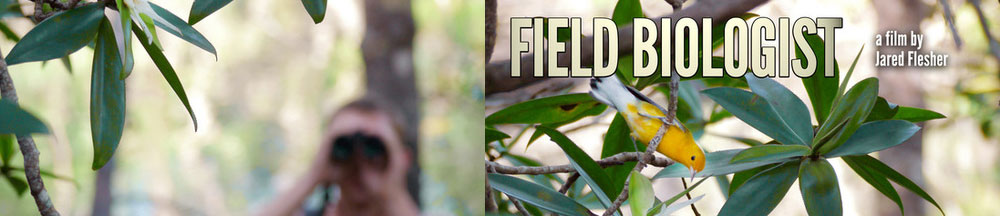
More Background On FieldBiologistMovie.com
FieldBiologistMovie.com served as the official online home for Field Biologist, a 2012–2014 environmental documentary directed by independent filmmaker Jared Flesher. While the site is no longer active in its original form, archived versions reveal that it functioned as a central information hub for the film’s development, release, festival screenings, educational distribution, and behind-the-scenes insights. The documentary follows the real-life story of an early-career naturalist—22-year-old Tyler Christensen—as he travels to Costa Rica to conduct independent field research on migratory birds without the institutional backing typically expected in formal scientific study.
The website highlighted the film’s purpose: to inspire interest in biodiversity conservation by centering a young individual’s curiosity, determination, and unconventional path into scientific work. It combined film-specific details with broader educational goals, including public awareness of habitat loss, climate change, and the consequences of development across migratory paths.
FieldBiologistMovie.com also linked viewers to the film’s distributor, festival screenings, director’s notes, production blog posts, multimedia content, and opportunities for educators to obtain licensed copies. While modest in aesthetic design, the website played a crucial role in enabling the film to gain visibility across environmental organizations, independent film circuits, and academic institutions.
Ownership and Creative Leadership
The website and film were owned and created by Jared Flesher, an environmental filmmaker known for journalistic storytelling focused on sustainability, conservation, and agriculture. Flesher’s production company—often branded under his personal name or through partnerships—has produced several acclaimed independent documentaries including:
-
The Farmer and the Horse (2010)
-
Sourlands (2012)
-
Field Biologist (2012–2013)
Flesher brought a background in investigative reporting and photojournalism to the production. His work has appeared in outlets such as:
-
The New York Times Online
-
The Wall Street Journal Online
-
The Christian Science Monitor
-
Grist
-
Edible Jersey, where he has served as editor
The ownership of FieldBiologistMovie.com itself was tied to Flesher’s filmmaking activities, acting as the project’s primary promotional and informational resource.
Goals and Mission of the Website
FieldBiologistMovie.com was designed to support several key goals:
1. Promote the documentary to an international audience
The site offered a trailer, synopsis, festival announcements, and endorsements from scientists, educators, and environmental organizations.
2. Support conservation education
A major portion of the site was dedicated to explaining the scientific and ecological issues behind the story, especially the threat to migratory birds and the fragile habitats they rely upon in both North and Central America.
3. Provide background on the protagonist and research site
Tyler Christensen’s unconventional journey into field biology was framed as both inspirational and instructive, breaking down barriers to public involvement in conservation.
4. Serve as a teaching resource
Through links to distributors such as Collective Eye Films, the website promoted educational licensing for high schools, universities, nonprofit groups, teacher workshops, and environmental centers.
5. Document the filmmaking process
The site hosted production blogs documenting on-location challenges, equipment considerations, logistical obstacles, wildlife encounters, and reflections on storytelling.
Synopsis and Themes as Presented on the Site
The central story follows Tyler Christensen, a young naturalist from New Jersey who travels to Costa Rica to conduct hummingbird and migratory bird research despite lacking formal academic credentials. His journey demonstrates persistence, improvisation, scientific curiosity, and deep environmental commitment.
The film explores several intertwined themes:
Identity and Pathways into Science
What makes someone a “real” scientist? Is it curiosity, formal training, or practical experience?
Biodiversity Crisis
The documentary highlights species vulnerability—particularly migratory songbirds and the endangered mangrove hummingbird.
Climate Change and Habitat Loss
Through field observations and interviews, the film addresses threats to tropical and temperate ecosystems.
Conservation Collaboration
The story illustrates how volunteer-driven research stations, like the Nicoya Peninsula Avian Research Station (NPARS), work with local communities to preserve habitat.
Exploration as Personal Growth
Tyler’s journey raises existential questions—about purpose, passion, and the role of risk-taking in crafting an unconventional career.
Popularity, Audience, and Reception
Field Biologist appealed strongly to:
-
environmental educators
-
birding enthusiasts
-
university biology departments
-
conservation NGOs
-
documentary film audiences
-
students considering environmental careers
The film was widely well-received across environmental and academic circles. Several festivals praised its balance of humor, scientific insight, and visual beauty. Endorsements featured on the website came from festival directors and scientific leaders alike, including:
Rebeka Ryvola, Environmental Film Festival at Yale
She praised the film’s stunning nature cinematography and described Tyler as “stealing the audience’s heart.”
Sir Peter Crane, Yale School of Forestry & Environmental Studies
Crane highlighted the accessibility of the film and its ability to inspire engagement with environmental science among non-scientists.
Reception from viewers often centered on Tyler Christensen’s authenticity and Flesher’s grounded approach to filmmaking. Many expressed admiration for Tyler’s dedication and the intimate look into real-world fieldwork.
Film Festival Screenings and Awards
Field Biologist was selected by a wide range of environmental film festivals across North America, Australia, and Europe. As detailed across archived pages, the film appeared at:
-
Environmental Film Festival at Yale
-
Princeton Environmental Film Festival
-
Environmental Film Festival Australia
-
Barcelona International Environmental Film Festival
-
One Earth Film Festival
-
Colorado Environmental Film Festival
-
Environmental Film Festival in the Nation’s Capital
-
Westwood Green Screen Environmental Film Festival
-
Thunder Bay Environmental Film Festival
-
Somewhat North of Boston Film Festival
-
Schiff Environmental Film Festival
-
RVA Environmental Film Festival
While the site did not display a list of specific awards, its selection in prestigious environmental festivals indicates strong peer recognition and credibility.
Historical Background of the Film and Website
The FieldBiologistMovie.com domain likely launched in 2012 or early 2013 to coincide with production and festival promotion.
Development (2012)
Flesher traveled to Costa Rica beginning in December 2012 to follow Tyler Christensen and the NPARS team. Early blog posts chronicled equipment trials, packing dilemmas, logistical challenges, and first wildlife encounters.
Filming Locations
The production took place in:
-
Monteverde Cloud Forest Reserve
-
Nicoya Peninsula and mangrove ecosystems
-
Research stations near coastal and upland forest transitions
These areas are hotspots for avian biodiversity and popular among ecotourists and ornithologists.
Post-Production (2013)
Archived content shows regular updates through early 2013, outlining editing progress, scientific context, and field anecdotes used to shape the narrative.
Release and Premiere (2013–2014)
The website promoted screenings at major film festivals throughout 2013–2014. It also offered viewing information for educational settings.
Educational Distribution
Collective Eye Films became the primary distributor, with the film offered for institutional licensing at a standard educational rate.
Behind-the-Scenes Content Documented on the Website
One of the site’s most valuable elements was the production journal, which gave viewers a candid look into the making of a field-based documentary.
Challenges of Filming in Tropical Environments
Flesher described:
-
constant humidity
-
equipment vulnerability to moisture
-
transportation logistics
-
handling heavy packs while hiking rugged terrain
-
attempting to record butterflies that produce audible wing “cracks”
-
dodging snakes, ants, and tropical storms
His approach emphasized “traveling light while maintaining redundancy,” carrying multiple cameras, microphones, and hard drives.
Scientific Anecdotes
The site shared unusual discoveries, such as encountering a “cracker butterfly” species whose wings produce snapping sounds—something neither Christensen nor Flesher had previously documented.
Birding Adventures
One notable blog post narrates the race to locate the elusive three-wattled bellbird, involving rapid gear changes, hiking through dense vegetation, and coordinating between team members positioned at different elevations.
The Monteverde Quetzal Search
Christensen’s reflections on encountering the resplendent quetzal highlight the emotional dimension of field biology and underscore the species’ cultural significance in Costa Rica.
Cultural, Social, and Scientific Significance
FieldBiologistMovie.com contributed to broader conversations about environmental responsibility and the accessibility of scientific careers.
Democratizing Science
The film challenges strict academic pathways by showing how someone with passion, focus, and discipline can contribute meaningfully to scientific research.
Raising Awareness of Biodiversity Loss
Through visual storytelling and site content, the creators promoted understanding of climate impacts, deforestation, and habitat fragmentation.
Encouraging Youth Engagement
The documentary became popular among educators for motivating students interested in:
-
zoology
-
ecology
-
ornithology
-
wildlife conservation
-
environmental science
Highlighting Volunteer-Driven Research
NPARS demonstrates that important scientific work can be driven by small, dedicated teams supported by volunteer labor and modest funding.
Cross-Continental Ecological Connections
The film directly connects New Jersey’s Sourland Mountains to Costa Rica’s mangrove ecosystems, educating viewers about migratory routes and global ecological interdependence.
Availability and Distribution
While the FieldBiologistMovie.com domain is no longer active, the film remains accessible through:
-
Collective Eye Films (educational licensing)
-
Environmental festivals hosting retrospective screenings
-
Public libraries that acquired institutional copies
-
University media collections
Its continued use in classrooms and environmental programs demonstrates the film’s ongoing relevance.
Lasting Legacy of FieldBiologistMovie.com
The website played a crucial role during the film’s most active distribution phase, serving as the central communication and promotional channel. Even after its decline in active updates, archived versions continue to act as a valuable resource for researchers, educators, conservationists, and independent film historians.
Field Biologist itself endures as an inspirational case study in independent conservation filmmaking, demonstrating how small-scale documentary projects can influence global environmental awareness and inspire a new generation of field scientists.